Best day to fill up in France? Monday saves 0.4 cents, the right station nearly 8
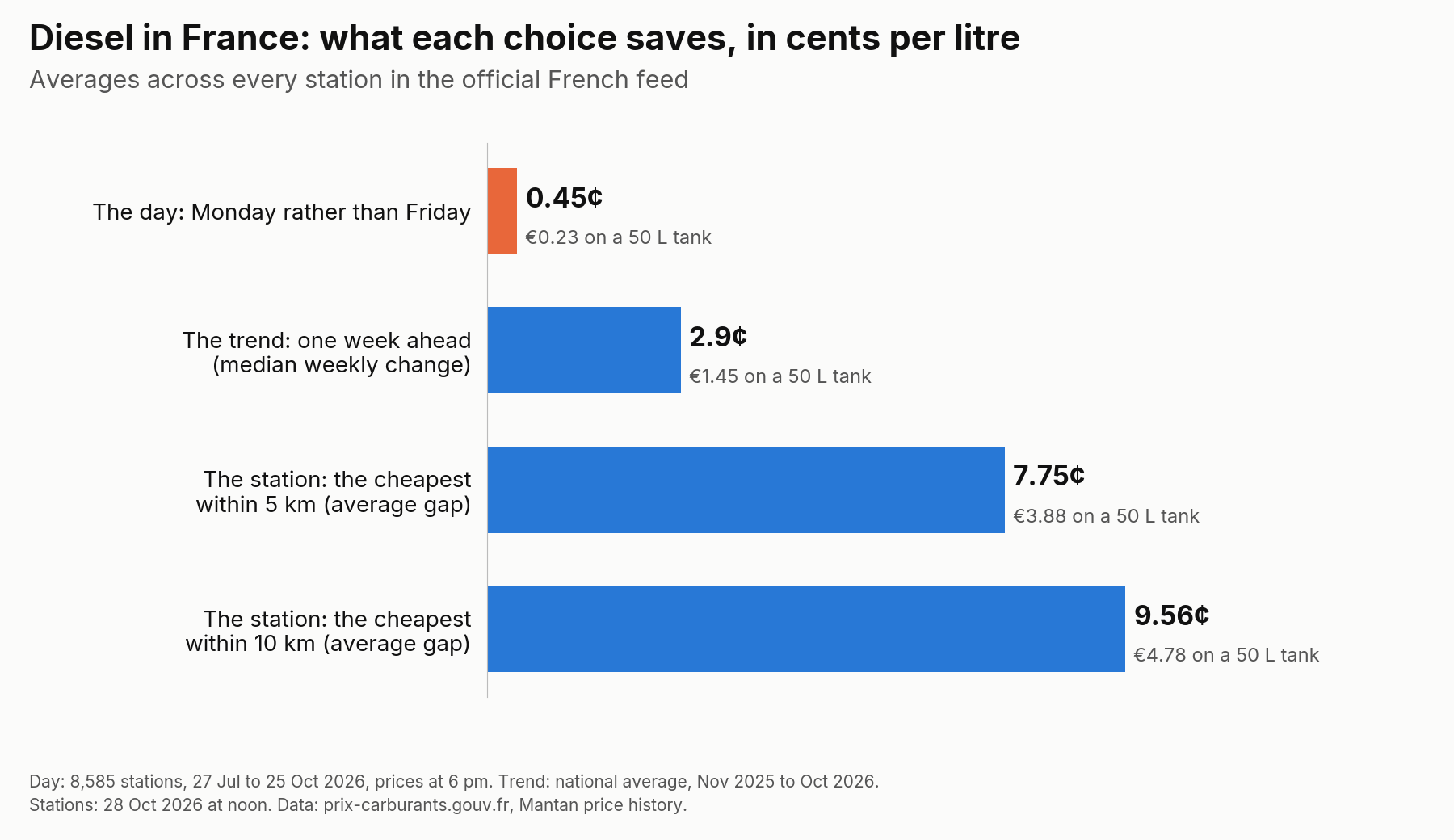
The day you fill up makes almost no difference: between the cheapest and the most expensive day of the week, the average gap is 0.45 cents per litre of diesel, or 23 euro cents on a 50-litre tank. Your choice of station matters 17 times more: in France, a station charges on average 7.75 cents more per litre than the cheapest one within 5 km.
These figures come from Mantan's price history: 8,585 French stations, 173,473 changes to the price of diesel and 129,795 changes to the price of E10, recorded from the official prix-carburants.gouv.fr feed over 13 weeks, from Monday 27 July to Sunday 25 October 2026.
The day: less than half a cent
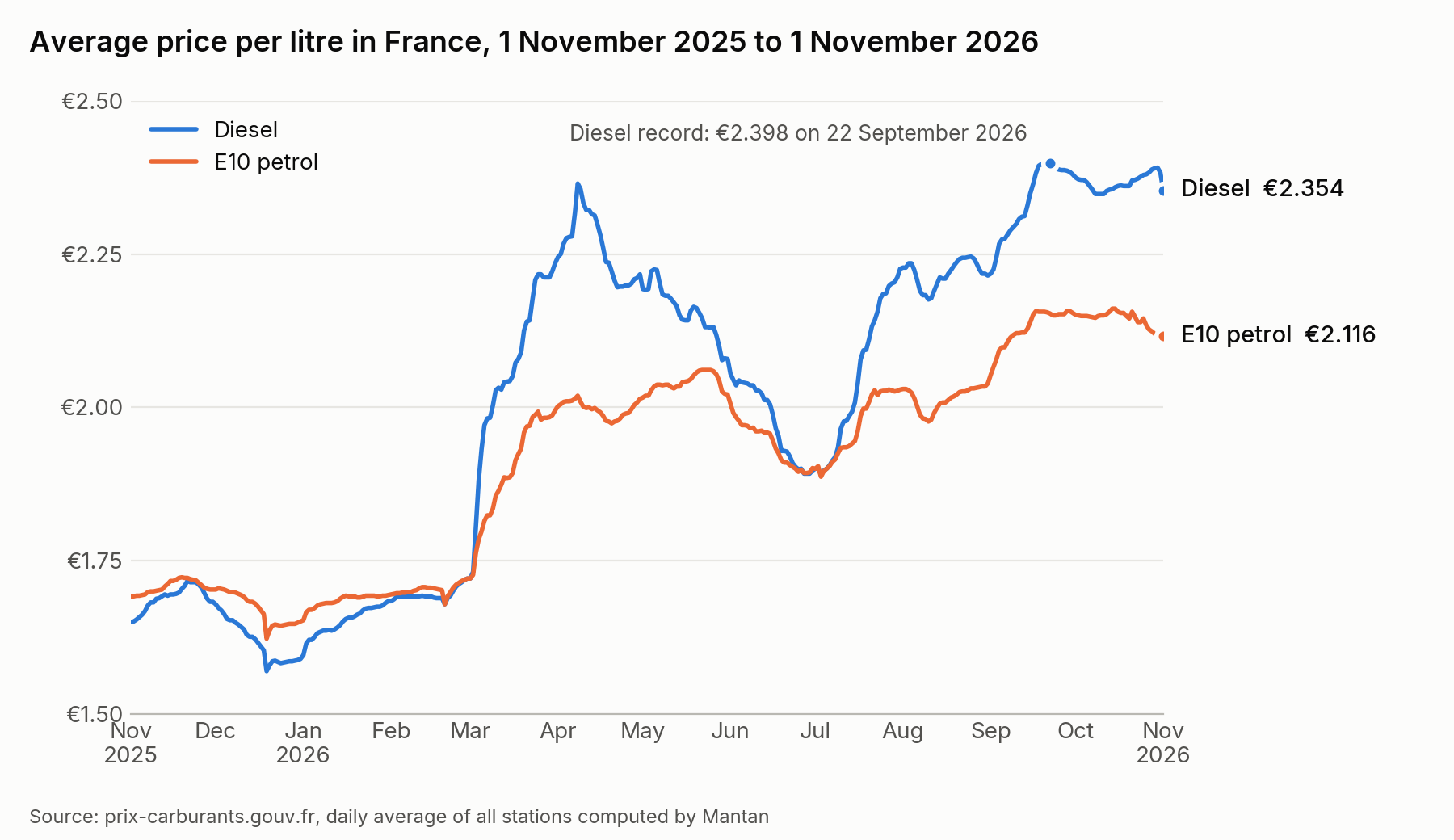
For each station, we compared its 6 pm price, day by day, with the average of the surrounding 7 days. This removes the underlying trend: over those 13 weeks, the national average price of diesel rose from €2.198 to €2.379, and without that correction Monday would look cheaper simply because it starts each week.
| Day | Diesel | SP95-E10 |
|---|---|---|
| Monday | −0.17 ¢ | −0.23 ¢ |
| Tuesday | −0.12 ¢ | −0.03 ¢ |
| Wednesday | −0.07 ¢ | +0.14 ¢ |
| Thursday | +0.07 ¢ | +0.19 ¢ |
| Friday | +0.28 ¢ | +0.14 ¢ |
| Saturday | −0.02 ¢ | −0.09 ¢ |
| Sunday | −0.17 ¢ | −0.18 ¢ |
Average gap between the 6 pm price and the same station's average price for the week, in euro cents.
Sunday evening and Monday are the cheapest, Thursday and Friday the most expensive. At best, picking your day saves 0.45 cents per litre of diesel (Monday rather than Friday) and 0.42 cents per litre of E10 (Monday rather than Thursday): 21 to 23 euro cents per tank. With 8 am prices the order shifts a little (Saturday morning becomes the most expensive for diesel), and the gap stays between 0.35 and 0.40 cents.
The daily national averages for the last 400 days give the same order of magnitude: a 0.41-cent gap for diesel between Sunday, the cheapest, and Wednesday.
On Sundays, prices barely move
Share of diesel price changes by day:
| Monday | Tuesday | Wednesday | Thursday | Friday | Saturday | Sunday |
|---|---|---|---|---|---|---|
| 14.6% | 17.1% | 16.7% | 18.3% | 21.6% | 10.2% | 1.5% |
Friday accounts for one change in five. On Sunday almost nothing moves: at the vast majority of stations, the price shown on Saturday evening is Sunday's price.
A station changes its diesel price a little more than once a week: 16 times in 13 weeks for the median station, usually by 2 cents. 217 of the 8,585 stations did not change it once.
The time: prices change in the morning
52.6% of diesel price changes happen between 7 am and 11 am, and 7.4% between midnight and 1 am. Only 17.3% happen after 2 pm. For any given station, the probability that it changes its price between 2 pm and midnight on a given day is about 4%.
In practice, a price you spot at lunchtime will almost always be the same on your way home from work. Times are those at which Mantan saw the change, to within 10 minutes: the official feed is read every 10 minutes.
The trend: 2.9 cents a week
From 1 November 2025 to 31 October 2026, the national average price of diesel moved by a median 2.9 cents a week, up or down: 6 times the effect of the day. One week in four (27%), the move exceeded 5 cents. The record of the year: +27.1 cents between 2 and 9 March 2026. For E10, the median weekly change is 1.6 cents.
Knowing which way prices are heading is therefore worth more than choosing your day. On Mantan, each station's page gives a verdict: "Fill up today: prices are rising", "You can wait a few days: prices are falling" or "Prices are stable: fill up whenever you like". It combines the station's 7-day history with the price of Brent crude in euros, which pump prices follow with a lag of one to two weeks.
The station: 7.75 cents on average
On Wednesday 28 October 2026 at noon, across the 6,405 stations with at least one neighbour within 5 km, the average gap with the cheapest station in that radius was 7.75 cents per litre of diesel: €3.88 on a 50-litre tank. 4 stations in 10 were at least 10 cents above it. Within 10 km, the average gap rises to 9.56 cents. For E10: 7.50 cents within 5 km, 9.40 cents within 10 km.
In the largest French cities, at the same time, within 5 km of the city centre:
| City | Stations | Cheapest diesel | Most expensive | Gap |
|---|---|---|---|---|
| Paris | 23 | €2.250 | €2.599 | 34.9 ¢ |
| Marseille | 21 | €2.250 | €2.549 | 29.9 ¢ |
| Lyon | 26 | €2.250 | €2.509 | 25.9 ¢ |
| Nantes | 19 | €2.250 | €2.499 | 24.9 ¢ |
| Bordeaux | 16 | €2.250 | €2.459 | 20.9 ¢ |
| Lille | 19 | €2.250 | €2.459 | 20.9 ¢ |
| Toulouse | 19 | €2.250 | €2.455 | 20.5 ¢ |
| Strasbourg | 15 | €2.250 | €2.876 | 62.6 ¢ |
In all 8 cities, the cheapest station showed the same price, €2.250, most often a TotalEnergies station. In Strasbourg, the most expensive is a motorway service area on the A35, in Ostwald. For E10, the cheapest was €1.990 everywhere except Bordeaux (€2.036).
The detour costs something, but not much: a 10 km round trip uses €1.42 of diesel in an average diesel car (5.93 litres per 100 km according to the French ecology ministry's 2024 traffic report, at the average price on 28 October, €2.388). And more often than not, the cheaper station is already on your way.
In short
- The day: it is worth less than half a cent. If you have the choice, Sunday evening or Monday.
- The time: prices move in the morning. In the afternoon, the price on display almost always holds until the evening.
- The trend: a median 2.9 cents a week. Check the station's verdict before filling up or waiting.
- The station: 7.75 cents on average within 5 km, €3.88 per tank. This is the choice that pays the most.
On the Mantan map, the cheapest station around you is highlighted, with the time each price was last updated. Free, no ads, no account.
Sources: prix-carburants.gouv.fr feed (French Ministry of the Economy, Etalab 2.0 open licence); price histories of Mantan's 8,728 French stations (/api/v1/history/fuel-fr/<station>, last 100 days) and daily national averages (/api/v1/history/fuel-fr), read on 2 November 2026 between 9:45 and 9:50 am Paris time; average consumption: 2024 traffic report of the French Ministry for Ecological Transition.